|
|
I'm a PhD candidate in the Department of History at the University of Sydney. I'm currently based in the Race and Ethnicity in the Global South Research Collaboration. My research interests include histories of youth, gender, welfare, education and disability. I have a keen interest in digital history and all things web. My dissertation is titled "Help Us/Help Them: How Australian parents understood the problem of mental retardation, and what they did about it, 1945-1970."
|

History SOTL – An Annotated Bibliography

History SOTL Introduction
Pace, D. (2004). The Amateur in the Operating Room: History and the Scholarship of Teaching and Learning. The American Historical Review, 109(4), 1171-1192.
http://www.jstor.org/stable/10.1086/530753
Is there a gulf between our disciplinary knowledge and our knowledge of teaching and learning? David Pace think so, and argues for the scholarship of teaching and learning history to be taken more seriously.
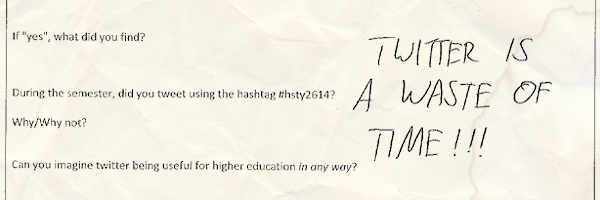
We often here how today’s students love technology. So do I. I also like to play a bit and try and see how we can best use it to enhance our higher education teaching.
This past semester I’ve been teaching Australian Social History (HSTY2614), a survey course which spans from 1918 through to today. As lead tutor for the course, I tried to engage the students through a range of online initiatives. This included a set of online resources available through the custom bit.ly address bit.ly/hsty2614; email updates providing responses to in-tutorial activities such as setting class rules and a stop/start/continue peer -review exercise; a webCT site offering lecture recordings; and (something new) a twitter hashtag for the course.
Twitter is what I discuss here. Read more…

Abstract for my upcoming paper at Connections, Australian Historical Association national conference in Adelaide, 2-6 July 2012.
The New Disability History, which seeks to trace the changing meanings attached to impairments over time, has alerted us to the contingent and protean nature of disabilities, and exposed the fuzzy boundaries between embodied impairments and culturally constructed disablements. The borderlands of disabilities are often diffuse, and different groups of individuals have moved within or through them over time.
In the decades immediately following the Second World, the group of classifications we now call ‘intellectual disabilities’ was in a state of flux. Australian parents with ‘mentally retarded’ youngsters had emerged as a new political force, organising themselves into large, influential voluntary bodies, and driving particularly rapid shifts in both popular and scientific understandings of who constituted the ‘mentally retarded’ group, and the needs, abilities and potentialities of its constituents. Read more…
1950s Suburban Domesticity: Living the Dream?

HSTY2614 Australian Social History Resources

The Course
Hashtag #HSTY2614 on Twitter
Tweet your readings before the tutorial. What do you think? Can it be summarised in less than 140 characters?
Readings at the Library e-reserve
Further readings at the library Read more…
The Rise of the Nuclear Family in Australia

Resources for Sydney University Summer School lecture to HSTY2614, “Australian Social History”: The Rise of the Nuclear Family


 Dave Earl - Disability history in Australia and the world